
Promoting the road safety culture among young people requires action from society as a whole

Under the leadership of Minister Lulu Ranne, the Finnish Ministry of Transport and Communications has started to prepare reforms to the current Driving Licence Act. The focus will probably be on the exemption procedure, whereby an application for a special permit for a driving licence can be submitted as early as at the age of 17. That’s very good! The police have consistently wanted to draw the attention of legislators to the fact that an exemption permit should be a real exemption permit.
Statistics confirm the concern expressed by the police about the traffic behaviour of 17-year-olds
According to statistics on road traffic accidents by Statistics Finland, a total of 13 young 17-year-old drivers of passenger cars and vans died in road traffic in Finland in 2019 to 2024, while the corresponding number of deaths was one in 2013 to 2018 (see Figure 1). In 2019 to 2024, two more young people aged 17 years (total 10) died as passengers of passenger cars or vans than in the earlier period examined.
The number of traffic deaths among 17-year-olds has not increased in the same way in other modes of transport as in connection with passenger cars and vans during the periods in question. In 2013 to 2018, a total of twenty 17-year-olds died in road traffic, while in 2019 to 2024 the corresponding number was 34.
It can be speculated that if the age exemption system had not been introduced in 2018, the number of deaths among 17-year-olds in road traffic might have increased by a few at most – perhaps by 10 to 15 per cent – but not by 12 deaths, in other words by 70 per cent, as has happened now.

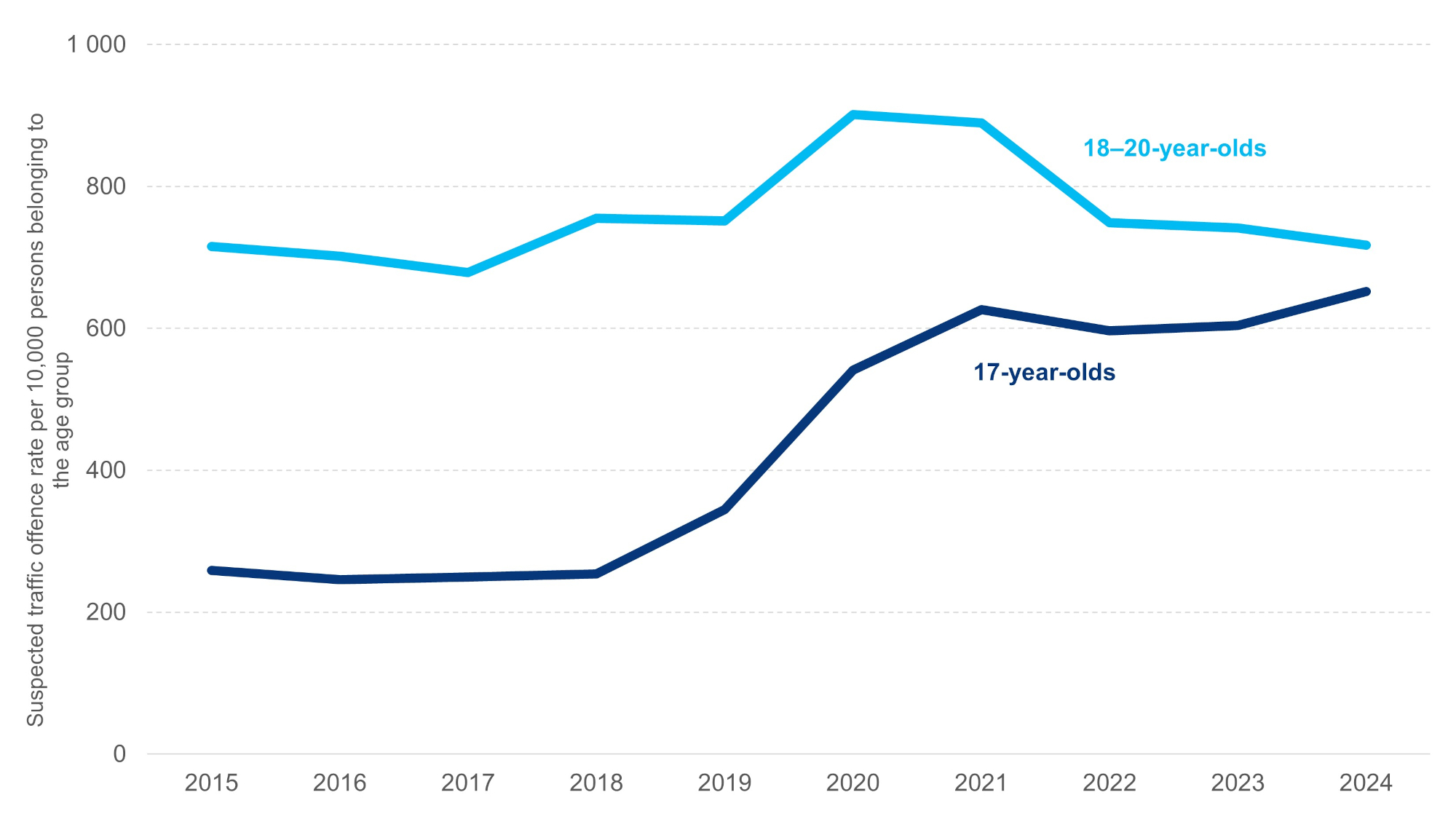
Road traffic accidents and deaths typically involve traffic offences, which means that the tragic events are often preceded by one or more suspected traffic offences. Taking into account the size of the age group, the number of traffic offences among 17-year-olds began go up sharply from 2018 onwards, and the level of traffic offences committed by 17-year-olds has almost reached the level of offences in the next older age groups (Figure 2). Traffic offences typically involve causing a traffic hazard and causing a serious traffic hazard, which are largely due to speeding. According to the data of the Finnish Crash Data Institute OTI, almost half of fatal accidents involved speeding of at least over 10 km/h over the limit.
The share of 17-year-olds in all road traffic deaths among those aged 15 to 24 has doubled when comparing the average relative shares in 2022 to 2024 and 2015 to 2017. The share was previously about 6 per cent, while in recent years it has been 11 per cent. There was a peak in 2020, when the share of 17-year-olds was as high as 27 per cent.
Attention in the improvement of traffic safety should be paid to the entire age group of young persons
When comparing the periods 2015 to 2017 and 2022 to 2024, traffic fatalities among young persons (aged 15 to 24) have decreased by about one quarter, but their share of all road traffic deaths has remained stable, at around 20 per cent (Figure 3). The share of other age groups has remained at slightly over 10 per cent, with the exception of young people, but also those aged over 75 years, whose share has risen slightly from around 15 per cent to 18 per cent.
.jpg/62ef13dc-c364-7e36-df9f-57a0f6ad76e0?t=1755785703803)
Not all young people are fully ready road users after receiving the right to drive. The risks associated with young drivers stem from factors such as inexperience and immaturity. Accidents involving young drivers are often related to speeding, driving under the influence of intoxicants, failure to use safety devices or swerving off the road, among other things, but these factors are actually reflections of adolescent’s actions, which are guided by other root causes.
According to research, risky behaviour is explained by attitude as well as by the underdevelopment of the brain of young people, especially young men. This underdevelopment contributes to young people’s readiness to take risks in traffic, which leads to serious accidents.
A small risk group causes a disproportionately big number of serious accidents. According to studies, the behaviour of this risk group in traffic is generally associated with a lifestyle coloured by antisocial behaviour, such as intoxicants, smoking and other risky types of behaviour.
Social pressure and friends who incite the driver are also associated with the risky behaviour of many young people in traffic. Fellow passengers are known to have a connection with the risky behaviour of young drivers in traffic and with the increased number of accidents.
How can we prevent young people from dying in traffic?
It is easy for the police to agree with the potential legislative changes that have been presented in public about the exemption for 17-year-olds to obtain a category B driving licence. Changing the current exemption procedure so that a 17-year-old could only be granted the right to drive for a special reason in clearly extraordinary situations would have a major impact on young people’s road safety.
The obligation to mark a passenger car driven by a person under a special permit is certainly a good thing, as is the night-time driving ban. It would also be justified to limit the number of people on board the vehicle, and related to that, to consider a model in which 17–18-year-olds should have a co-driver who is at least 25 years old during the first year of their driving licence.
A driving ban history and traffic offence history could prevent obtaining a category B driving licence with an exemption permit or at the age of 18. At the moment, the traffic offence history does not matter, but the police have found that in practice it is an indication of future traffic behaviour when driving a passenger car. It could also have an impact on traffic behaviour at a younger age, when adolescents would know that previous traffic offences matter if you want to have a category B driving licence.
In terms of driving health requirements, it would be a good idea to introduce a medical examination in connection with the issuance of the first driving licence and in connection with the renewal of the driving licence.
There are also many other good ways to prevent the deaths of young people in traffic.
Towards a culture of caring
Everyone’s life is important, and life must be protected. Even when enacting legislation, society has to consider the order of importance of objects of legal protection and also their weighting. We certainly cannot ignore research-based knowledge or methods that are known to be important for young people’s road safety and affect the underlying factors behind the root causes.
Traffic safety, both among young people and any other road users, is not just about following the rules – it is about caring: about yourself, your passengers and other road users. In accordance with the road safety strategy, this is something shared by the whole society. We as a society must build a culture where safety prevails over urgency or the need to show off.
Only then can we prevent unnecessary deaths and give young people the opportunity to grow up safely.